
TL;DR: Gas sensors only protect people and plants when the sensing technology matches the gas and application, backed by good placement and regular maintenance.
Key Takeaways:
- Different sensor types suit different gases and conditions, from flammable hydrocarbons to toxic gases, oxygen, and VOCs.
- Strong gas detection programs mix fixed, portable, and personal devices so there are fewer blind spots on site.
- Routine bump tests, calibration, and sensor replacement keep alarms trustworthy and reduce the risk of false confidence.
- Working with a specialist helps turn individual detectors into an integrated system that supports clear, fast decisions.
If a gas leak started on your site right now, how long would it take your team to know for sure? For many facilities the honest answer is that no one really knows, because coverage, sensor choice, and calibration are often based on habit instead of a fresh look at the risks.
Here we break down the main types of gas sensors, where each one actually works best, and how they can cut guesswork so your people, plant, and community stay protected instead of relying on lucky near misses.
Gas Sensors: The Silent Guards Of Your Plant
Gas sensors sit quietly in the background while work goes on, then in a single alarm they become the first hard proof that something is wrong and people could be at risk.
When the right sensor is matched to the gas, the process, and the way people move around the plant, it turns an invisible hazard into clear numbers and simple alarms that operators can understand and act on quickly.
Types of Gas Sensors: What Sits Behind Every Alarm
Catalytic Bead Sensors For Flammable Gas
Catalytic bead sensors use a heated element that reacts with flammable gas and turns that reaction into a signal the detector can read. They burn a small amount of gas in a controlled way so you can see how close you are to a dangerous level.
They sit in detectors that measure gas as a percentage of the lower explosive limit for common gases like methane and propane. Many plants use them because they give straightforward feedback on flammable gas risk.
To picture where they fit on a site, keep a few points in mind:
- They work best in general plant and utility zones where flammable gas leaks are possible and ventilation is moderate.
- They need clean air flow plus regular bump tests and calibration to keep readings honest.
- Poisons such as silicones or lead compounds can slowly damage the sensing element, so some plants need tighter checks.
Infrared Gas Sensors For Hydrocarbons And CO₂
Infrared sensors send light through the gas and measure how much is absorbed at wavelengths that match each gas. That makes them a strong choice for flammable hydrocarbons and carbon dioxide, especially where oxygen levels are low.
They are used in fixed detectors and open path systems that watch across walkways, loading bays, and storage zones for leaks. They usually cost more upfront, but they stay stable over time and do not burn gas during normal operation.
Electrochemical Sensors For Toxic Gas And Oxygen
Electrochemical sensors use a liquid or gel electrolyte that produces a small current when the target gas reaches the cell. This design makes them very sensitive to toxic gases such as hydrogen sulphide, carbon monoxide, chlorine, and also to oxygen levels.
You will see these cells in personal gas detectors, portable multigas units, and fixed transmitters that watch confined spaces and process points with tight exposure limits. They have a set service life and can dry out or saturate, so they need planned checks and calibration if you want reliable alarms.
Semiconductor And Specialty Gas Sensors For High Tech Plants
Semiconductor sensors, sometimes called MOS sensors, change resistance when target gases touch a sensitive surface. That change in resistance becomes a signal the detector can use to show the gas level.
They are used for some toxic gases and for trace leak detection in semiconductor, specialty gas, and research facilities. To see how this works in real semiconductor fabs, read our advanced techniques for toxic gas detection in the semiconductor industry.
Photo Ionisation Detectors For VOCs
Photo ionisation detectors use ultraviolet light to ionise volatile organic compounds and then measure the small current that is created. This makes them a fast, sensitive way to see changes in total VOC levels rather than chasing one gas at a time.
You will often see PID sensors built into portable detectors used for tank entry, leak surveys, and spill response. One instrument can handle many different chemical mixes, which is why they are popular on busy industrial sites.
Gas Detector Tubes For Spot Checks
Colour change gas detector tubes give a quick reading for a single gas by drawing a set volume of air through a tube that changes shade. They are simple, need no power, and are easy for teams to use in the field.
On their own they are not a full time safety system, but they are useful for confirming readings from fixed or portable detectors. Many sites use them during maintenance, commissioning, and checks in remote locations as an extra crosscheck.
Matching Sensor Types To Fixed, Portable, And Personal Detection
Choosing types of gas sensors is only half the story, because you also need to decide where they sit and who carries them.
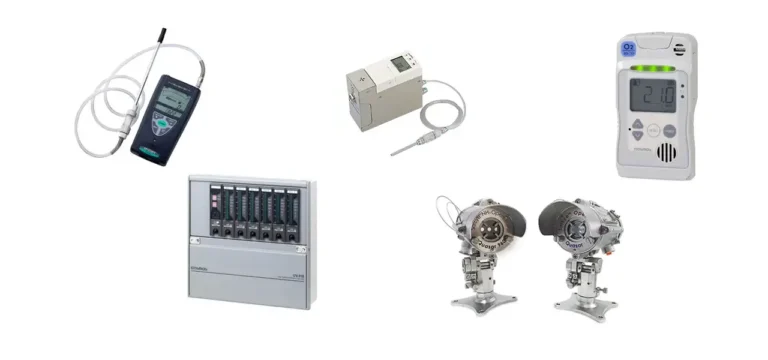
Most strong gas detection programs mix fixed systems, portable instruments, and personal wearables so no one walks into a blind spot.
Fixed Gas Detection Systems For Continuous Coverage
- Fixed gas detector transmitters watch process equipment, storage zones, and paths where gas could collect during normal operation or upset conditions.
- They feed signals back to local controllers or panels that can show live readings, raise alarms, and trigger fans, trips, or other actions when set points are crossed.
- Minerva designs fixed gas detection systems that integrate with plant PLC, BMS, DCS, or SCADA so gas readings become part of real control actions, not just flashing lights.
Open Path Detectors To Watch The Gaps
- Open path gas detectors send a beam between a transmitter and receiver so they can see a gas cloud that crosses the path anywhere along that line.
- They are strong over loading bays, tank farms, pipe racks, and large process bays where one point detector would leave large gaps.
Portable Gas Detectors For Work Fronts
- Portable gas detectors move with teams during shutdowns, commissioning, leak checks, and short term work fronts.
- They can be tuned to the gas mix at that job and give supervisors a way to verify that conditions are safe before work starts and while work continues.
Personal Gas Detectors For Individual Safety
- Personal gas detectors clip onto clothing or harnesses and stay within the breathing zone of the person wearing them.
- They alert that one person the moment their own exposure climbs, even if a fixed detector in the same zone is still under its alarm limit.
- Personal units are standard for confined space entry, walk downs, and work in zones with changing airflow where clouds can move quickly.
If you want a broader background on gas sensor technologies and how they are used, you can read our gas sensor types and innovations overview. It pairs well with this article when you are planning upgrades or training for your team.
Why Choose Minerva For Gas Sensors And Gas Detection
Minerva has over three decades of experience helping Malaysian sites protect life and assets through detection and monitoring solutions. The team focuses on gas and flame detection, flow metering, and remote asset monitoring, backed by real world experience and solid engineering.
For gas sensors and gas detection, Minerva supplies personal, portable, and fixed detectors, open path units, environmental monitors, custom systems, and flame detectors from trusted global partners. Customers across major industries also rely on Minerva for hazard mapping, system design, installation, calibration, and maintenance.
Ready To Talk About The Right Types Of Gas Sensors For Your Site
If you are not sure your gas sensors still match your processes and risks, it is better to review them now than explain a preventable incident later. The Minerva team can review your fixed and portable detectors, coverage, and settings to improve safety and uptime.


